
If you are wondering how to become a Scrum Master, 2026 is a great time to explore this career path. As more organizations adopt Agile methodologies to manage projects and build products, professionals who can facilitate collaboration, remove obstacles, and help teams continuously improve are becoming increasingly valuable.
The good news is that you do not necessarily need a technical degree or software development experience to become a Scrum Master. With the right Scrum knowledge, communication skills, practical experience, and certification, beginners can build a successful career in Agile project delivery.
This guide explains how to become a Scrum Master in 2026, including the skills you need, certification options, career paths, and how to enter the field without prior experience.
What Is a Scrum Master?
A Scrum Master is responsible for helping a Scrum Team understand and effectively apply the Scrum framework.
The Scrum Master acts as a facilitator, coach, and servant leader rather than a traditional manager. Their goal is to help the team work effectively, identify and remove impediments, improve collaboration, and continuously improve the way they work.
A Scrum Master commonly works with:
- Developers
- Product Owners
- Stakeholders
- Project managers
- Delivery teams
- Business and technology teams
Understanding this role is the first step in learning how to become a Scrum Master.
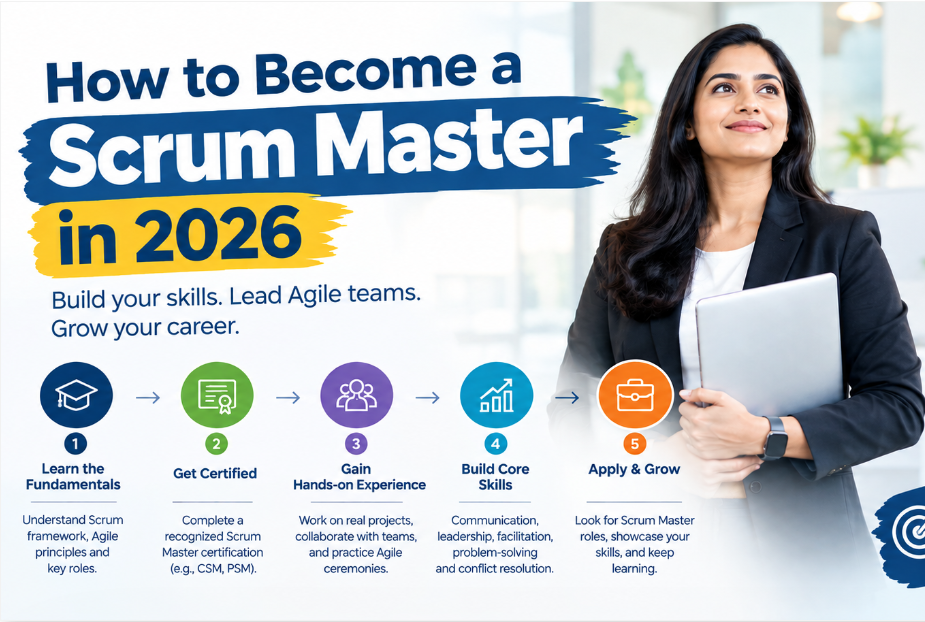
How to Become a Scrum Master in 2026
If you are starting from the beginning, follow a structured learning path.
1. Learn the Fundamentals of Agile and Scrum
Before applying for Scrum Master positions, understand the basics of Agile and Scrum.
You should learn about:
- Scrum principles
- Scrum values
- Scrum Team
- Product Owner
- Scrum Master
- Developers
- Product Backlog
- Sprint Backlog
- Increment
- Sprint Goal
- Product Goal
- Definition of Done
- Sprint Planning
- Daily Scrum
- Sprint Review
- Sprint Retrospective
Understanding why these concepts exist is more important than simply memorizing Scrum terminology.
2. Develop the Skills Required to Become a Scrum Master
Technical Scrum knowledge alone does not make someone a successful Scrum Master.
Some of the most important skills required to become a Scrum Master include:
Communication
Scrum Masters regularly communicate with team members, Product Owners, stakeholders, and leadership. Strong communication helps teams work toward common goals.
Facilitation
A Scrum Master facilitates meetings and discussions while ensuring that everyone has an opportunity to contribute.
Coaching
Scrum Masters help teams understand Agile principles and encourage them to become more self-managing.
Conflict Resolution
Teams can experience disagreements and misunderstandings. A Scrum Master helps create an environment where conflicts can be addressed constructively.
Problem-Solving
Removing impediments is an important part of the role. Scrum Masters need to identify obstacles and help teams find solutions.
Leadership
Scrum Master leadership is based on serving and enabling the team rather than controlling it.
Adaptability
Every organization and Scrum Team is different. A good Scrum Master adapts their approach according to the team’s needs.
How to Become a Scrum Master With No Experience
One of the biggest questions beginners ask is how to become a Scrum Master with no experience.
You can start without direct Scrum Master experience by building transferable skills and gaining practical exposure to Agile ways of working.
Start by:
- Learning Agile and Scrum fundamentals.
- Taking a beginner-friendly Scrum Master course.
- Earning a recognized Scrum certification.
- Practicing Scrum events through simulations.
- Learning Agile project management tools.
- Participating in Agile projects at work.
- Volunteering to facilitate meetings or retrospectives.
- Applying for entry-level Agile and project coordination positions.
Relevant beginner roles may include:
- Agile Coordinator
- Project Coordinator
- Scrum Master Trainee
- Junior Scrum Master
- PMO Analyst
- Agile Project Coordinator
- Delivery Coordinator
The objective is to build evidence that you can facilitate teams, communicate effectively, solve problems, and support Agile delivery.
How to Become a Scrum Master Without a Technical Background
Another common question is how to become a Scrum Master without a technical background.
The good news is that coding is not a core requirement for becoming a Scrum Master.
Professionals from backgrounds such as business, management, operations, HR, customer service, project coordination, and other fields can transition into Scrum.
However, having basic technical awareness is helpful.
You should understand concepts such as:
- Software development lifecycle
- Testing
- Product development
- Releases
- APIs
- Cloud technology
- Development environments
You do not need to become a programmer. Instead, focus on understanding enough technology to communicate confidently with technical teams.
How to Become a Certified Scrum Master in India
If you want to know how to become a certified Scrum Master in India, start by researching recognized Scrum certification providers.
Popular certification options include:
- Certified ScrumMaster (CSM)
- Professional Scrum Master (PSM)
- SAFe Scrum Master
- Other recognized Agile and Scrum certifications
The general process involves:
Step 1: Choose a Certification
Compare certification requirements, training options, examination formats, costs, and renewal policies.
Step 2: Complete Scrum Training
A structured course can help you understand Scrum concepts and prepare for certification.
Step 3: Study and Practice
Focus on Scrum principles, accountabilities, events, artifacts, and real-world scenarios.
Step 4: Complete the Assessment
Depending on the certification, you may need to pass an online or proctored assessment.
Step 5: Gain Practical Experience
Certification gives you foundational knowledge, but practical experience is essential for building a long-term Scrum Master career.
Scrum Master Certification for Beginners: Is It Necessary?
A Scrum Master certification for beginners can be useful because it gives you a structured way to learn Scrum and demonstrates your commitment to the field.
However, certification alone does not guarantee a Scrum Master job.
Employers may also look for:
- Communication skills
- Facilitation ability
- Leadership
- Agile knowledge
- Problem-solving
- Team collaboration
- Practical experience
- Knowledge of Agile tools
Therefore, combine certification with hands-on learning and relevant professional experience.
How to Start a Career as a Scrum Master
If you want to know how to start a career as a Scrum Master, create a step-by-step plan.
Beginner Stage
Learn:
- Agile fundamentals
- Scrum framework
- Scrum roles and accountabilities
- Scrum events
- Scrum artifacts
- Agile principles
Skill Development Stage
Build:
- Communication
- Facilitation
- Coaching
- Conflict resolution
- Leadership
- Problem-solving
Practical Stage
Work on sample Scrum projects, participate in Agile teams, or take opportunities to coordinate projects and facilitate team discussions.
Certification Stage
Choose a certification aligned with your career goals.
Job Search Stage
Create a resume highlighting your Scrum knowledge, certification, Agile experience, transferable skills, and measurable achievements.
How Long Does It Take to Become a Scrum Master?
Many beginners ask, how long does it take to become a Scrum Master?
There is no fixed timeline. It depends on your previous experience, learning pace, and opportunities to gain practical experience.
A beginner may spend:
- 1–2 weeks learning Scrum fundamentals
- 2–4 weeks developing practical Scrum knowledge
- 2–6 weeks preparing for certification
- Several weeks or months building practical experience
Someone with previous project management or team leadership experience may progress faster.
Instead of focusing only on how quickly you can become certified, focus on becoming capable of helping a Scrum Team solve problems and continuously improve.
Scrum Master Career Path for Beginners
The Scrum Master career path for beginners can develop in several directions.
A typical progression may look like:
Project/Agile Coordinator
↓
Junior Scrum Master
↓
Scrum Master
↓
Senior Scrum Master
↓
Agile Coach / Delivery Manager / Agile Program Leadership
Your career does not have to stop at Scrum Master.
With experience, you can explore careers in:
- Agile coaching
- Delivery management
- Project management
- Program management
- Product management
- Agile transformation
- Engineering management
The right path depends on your interests and professional strengths.
What Does a Scrum Master Do Every Day?
A Scrum Master’s responsibilities can vary depending on the organization and team’s maturity.
Typical activities may include:
- Facilitating Scrum events
- Helping teams identify impediments
- Supporting the Product Owner
- Coaching team members
- Encouraging collaboration
- Supporting continuous improvement
- Helping teams understand Scrum
- Facilitating retrospectives
- Working with stakeholders
- Monitoring team improvement
A Scrum Master should focus on enabling the team rather than simply organizing meetings.
Best Scrum Master Course for Beginners
Choosing the best Scrum Master course for beginners depends on your career goals and learning preferences.
Before selecting a course, check whether it covers:
- Agile fundamentals
- Scrum framework
- Scrum roles and accountabilities
- Scrum events
- Scrum artifacts
- Sprint planning
- Backlog management
- Facilitation
- Coaching
- Conflict resolution
- Stakeholder communication
- Real-world scenarios
- Agile tools
- Certification preparation
A practical course that combines theory with real-world examples and exercises can be particularly valuable for beginners.
Common Mistakes to Avoid When Becoming a Scrum Master
Only Focusing on Certification
A certificate is useful, but practical skills matter just as much.
Memorizing Scrum Instead of Understanding It
Learn the purpose behind Scrum practices instead of memorizing definitions.
Ignoring Soft Skills
Communication, facilitation, coaching, and conflict resolution are central to the role.
Thinking You Need to Be a Developer
You do not need programming expertise, although basic technical knowledge can help.
Treating the Scrum Master as a Meeting Manager
A Scrum Master does much more than schedule and facilitate meetings. The role involves coaching, removing impediments, improving collaboration, and helping the team become more effective.
Frequently Asked Questions
Can I become a Scrum Master without IT experience?
Yes. A technical background is not mandatory. However, basic knowledge of technology and software development can help you collaborate with technical teams.
Can I become a Scrum Master with no experience?
Yes. Start by learning Scrum, earning a certification, developing transferable skills, practicing Scrum, and gaining experience through Agile or project coordination roles.
Do Scrum Masters need coding skills?
No. Coding is not a core requirement for the Scrum Master role. Basic technical understanding is useful but programming expertise is generally not required.
Is Scrum Master a good career in 2026?
Scrum Master can be a strong career option for professionals interested in Agile delivery, leadership, communication, team facilitation, and continuous improvement.
Is Scrum Master certification worth it?
Certification can provide structured learning and demonstrate foundational Scrum knowledge. For stronger career opportunities, combine certification with practical experience and interpersonal skills.
Final Thoughts
Learning how to become a Scrum Master is about much more than getting a certificate. A successful Scrum Master needs to understand Agile and Scrum while developing strong communication, facilitation, coaching, leadership, and problem-solving skills.
Whether you are a fresher, career switcher, project coordinator, experienced professional, or someone from a non-technical background, you can begin building your Scrum Master career with the right learning path.
Start by understanding Scrum, develop practical skills, choose a suitable certification, gain hands-on experience, and continue improving.
Your Scrum Master journey can start with learning—but it grows through practice.